

Obtaining of at least one model that allows the prediction of a more sustainable material/process than the selected benchmark while having comparable performances.
-
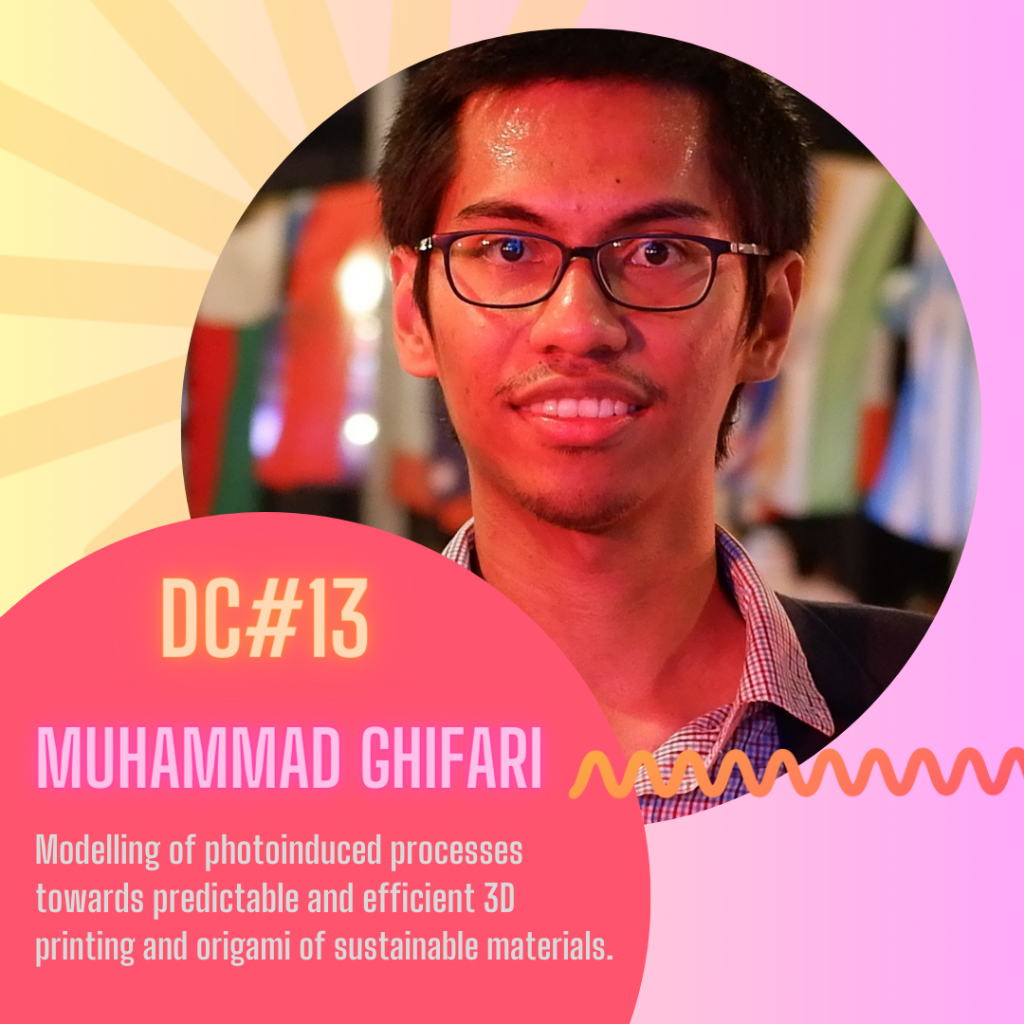
Establishment of a comprehensive and general modelling framework to describe photopolymerisation processes, enabling their control and increasing their efficiency and sustainability, by reducing chemical and energy consumption, and minimising trial-and-error failure and material waste.
-
Coupling of ‘minimal’ models focusing on physical observables for spatio-temporal conversion with mechanical property gradients that generate stress differentials to actuate 2D and 3D patterns into spontaneously forming structures, thereby reducing printing steps (material/energy) and augmenting function.
-
Parameterisation, testing and validation of the models with a series of experiments on custom-formulated radical polymerisation systems (academic secondment), predicting a plethora of well-organised patterns with prescribed profile and curvature, for applications in optics and photonics, structural colour, and autonomous (self-sustaining) curing systems.
-
Obtaining a modelling and manufacturing framework that permits the design and fabrication of more sustainable materials/processes than the existing selected benchmark while having comparable performance.
Comprehensive analytical and numerical modelling toolkit to predictively describe photopolymerisation process for both conventional and advanced material patterning.
-
Collection of experimental data on a representative chemical library for validation of the models.
-
Setting of appropriate sustainability metrics, and sustainability assessment of the materials/processes predicted by the new models, including chemicals, energy and time expended, as well as solvents used and waste generated.
-
Rained researcher expert in modelling, including numerical simulation, with experimental skills in photopolymerisation, acquired also during secondments.
HOST 1
POLITO (IT), supervisor: A. Vitale, timing: month 31, length: 6 months. Purpose: experimental validation of theoretical models for photoinduced frontal polymerisation.
HOST 2
LOGITECH (CH), supervisor: J. M. Chardon, timing: month 38, length: 3 months. Purpose: experimental validation of the predictive ability of theoretical models in industrial applications.
*Enrolment in Doctoral degree: at Imperial, in Chemical Engineering. Prof. J. Cabral will act as supervisor.